
Welcome to the project!
This site was born out of a simple realization: preserving our family history through digital archiving is incredibly rewarding, but the technical barrier to entry can be frustratingly high.
Whether you are looking to digitize a handful of family slides or catalog a massive multi-generational archive, I created this site to give you the clear, technical blueprints you need to do it yourself.
What We Are About (In a Nutshell)
To give you a quick bird’s-eye view of what I cover and why I do it, here is a perfect summary of this site’s mission:
Beyond the Shoebox: 9 Surprising Secrets to Digitizing Your Family Legacy
1. The Fragile Whisper of the Past
Family memories are often preserved as fragile whispers, tucked away in “magnetic” adhesive albums or dusty shoeboxes where they physically fade with every passing year. These relics—fading paper and curling edges—are more than mere objects; they are silent testaments to our origins.
The urgency of professional digitization is best illustrated by the “Ghost in the Photo” narrative. When Liam digitized a faded, blurry print for his grandmother, Ginny, the process revealed a “ghost” hidden in the muddy original. Through high-resolution capture and careful editing, the shadowy figure in the background was revealed as a young woman in a nurse’s uniform. With a gasp, Ginny identified her as “Great Aunt Sadie,” a beloved relative who served as a nurse and was tragically killed in France during the war. Digitization is our safeguard, ensuring that even as the physical original thins, the stories of people like Sadie remain protected and accessible.
2. Stop Calling it a Daguerreotype: The “Mirror vs. Magnet” Test
Before you touch a single piece of equipment, you must identify the substrate of your Victorian-era “cased images.” Understanding the physics of the material is the first rule of digitization.
- The Daguerreotype: Known as a “mirror with a memory,” these are silver-plated copper sheets. If you must tilt the plate to see the image—alternating between a positive and a negative view—it is a daguerreotype. Because of their mirror-like interference, you must never put a daguerreotype in a flatbed scanner; the direct light creates an unviewable, blown-out mess.
- The Tintype: These are produced on thin sheets of iron. They are darker, less reflective, and magnetic. Surprising truth: unlike their silver cousins, tintypes often thrive on a flatbed scanner. A high-resolution scan can beautifully capture the “japanned” matte texture of the iron plate that a camera might overlook.
- **The Ambrotype: These are “positives” on glass. You are holding an ambrotype if you can see depth in the image or if the black background appears to be flaking away from behind the portrait.
“The Daguerreotype: A mirror with a memory.”
3. The “Black Card” Trick: Re-activating Glass Ghosts
Ambrotypes require a specific, counter-intuitive technique. These images are actually underexposed glass negatives; they only appear as “positives” because they were originally backed with black velvet or black paint.
Over a century, this backing often rots, peels, or fades, causing the image to lose its contrast and disappear into a “glass ghost.” To re-activate a 150-year-old portrait, place a piece of high-quality black acid-free cardstock or black velvet directly behind the glass. This provides the necessary contrast to make the portrait “pop” for the camera lens, bringing the underexposed negative back to life as a clear, crisp positive.
4. Why Your Camera Beats Your Flatbed Scanner
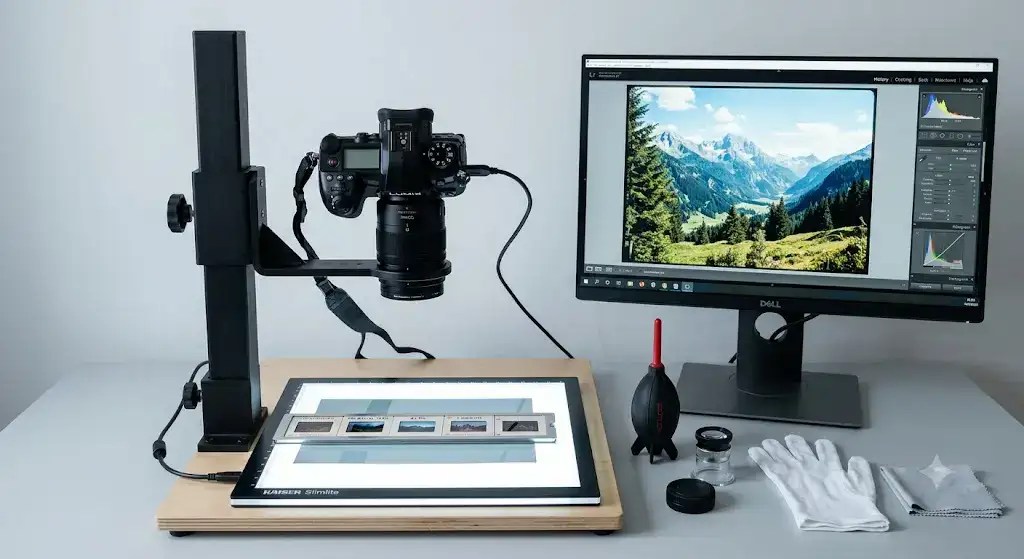
While flatbeds are convenient for certain tintypes, a mirrorless camera equipped with a 60mm (or longer) 1:1 macro lens is the museum-grade standard.
- Parallelism and the “Mirror Trick”: Alignment is everything. If your camera-to-baseboard alignment is off by even one degree, you lose edge-to-edge sharpness. Place a small mirror flat on the baseboard; if you see your lens centered in the reflection through the viewfinder, you are perfectly parallel.
- Color Science: To ensure professional results, use lighting with a Color Rendering Index (CRI) of 95+. Position two diffused LED panels at 45-degree angles to the print to minimize reflections and reveal “authentic texture.”
- Speed and Detail: Tethering your camera to a computer allows for a real-time workflow. You bypass the “import” step, applying file-naming conventions and checking focus at 100% zoom instantly.
5. The Resolution Paradox: Why Smaller Film Needs More Power
Archivists must respect the “Point of Diminishing Returns.” This is the stage where a sensor begins capturing the physical characteristics of the medium—the paper texture or film grain—rather than additional image detail.
- 8×10 Prints: Because these are large originals, a 24MP camera is more than sufficient to capture every visual nuance.
- 110-Format Subminiature Negatives: Because the surface area is so tiny, that same 24MP camera is actually the bare minimum required to capture necessary detail. High pixel density acts as a magnifying glass for small film rather than just over-sampling grain.
6. Don’t Name Your Photos “Grandma”: The Archive Code Strategy
To prevent your work from becoming a “digital shoebox,” use location indicators rather than image content. Filenames must act as signposts back to the physical media container.
- The KFA Prefix: Create a prefix based on your last name. For the Klein family, we use KFA (Klein Family Archive).
- The Convention: Use a code like KFA-AG01-ALB01-IMG01. This tells you the image is in Archive Group 01 (Albums), Album 01, Image 01.
- The Transcription Layer: Use the IPTC Description field as a “transcription layer” for documents. By copying raw text from an OCR engine into this field, you ensure that future AI-powered search tools can index your data set.
7. The “3-2-1” Rule for People: Building a Digital Succession Plan
An archive is only as good as the person prepared to “take the torch.” We adapt the 3-2-1 backup rule for humans to avoid “Data Overwhelm”:
- 3 People who know the archive exists.
- 2 Physical Copies of a “Letter of Instruction” (one with your Will, one in your desk).
- 1 Named Digital Executor in your legal documents.
- The “Gold” Folder: Create a folder named START_HERE_BEST_OF_COLLECTION. This prevents your heir from being buried under 50,000 unorganized files and ensures the most vital stories are seen first.
Digital Assets Will Clause “I give to my Digital Successor, [Name], full power to access, manage, distribute, and/or delete my digital assets. This specifically includes my ‘Family Digital Archive’ stored on [Physical Hardware/Cloud Service]. I authorize my Digital Successor to bypass or reset any passwords to recover these files for the benefit of my heirs.”
8. Rescuing Memories from “Legacy Fasteners”
Once your digital succession plan is in place, we must return to the front lines of physical preservation. The 1970s-style “magnetic” adhesive albums are an archival crisis. The acidic materials in these albums, along with “Legacy Fasteners”—rusted staples and brittle paperclips—are the secret villains of history.
To safely extract photos:
- The Extraction: Use dental floss to gently “saw” through old adhesive behind a print. Use micro-spatulas to carefully pry the photo away from the bond.
- The Warning: If you see paper fibers “lifting” or thinning during the removal of a staple or tape, stop immediately. A rusted fastener is an eyesore, but a hole in a document is a permanent loss of history.
9. Conclusion: Your Legacy Day Action Plan
Professional-grade preservation is now accessible, but it requires starting small. I challenge you to the “Ten-Photo Challenge”: select ten pictures this weekend, digitize them at museum quality, and record an oral history with your oldest living relative while they look at the screen. This visual stimulus is the key to triggering memories that would otherwise be lost.
As you build this bridge between the past and the future, ask yourself: “If your digital archive were discovered 50 years from now, would your great-grandchildren be able to find the keys to open it?”
Ready to preserve your treasures? Go to my home page and start digitizing at museum quality.